
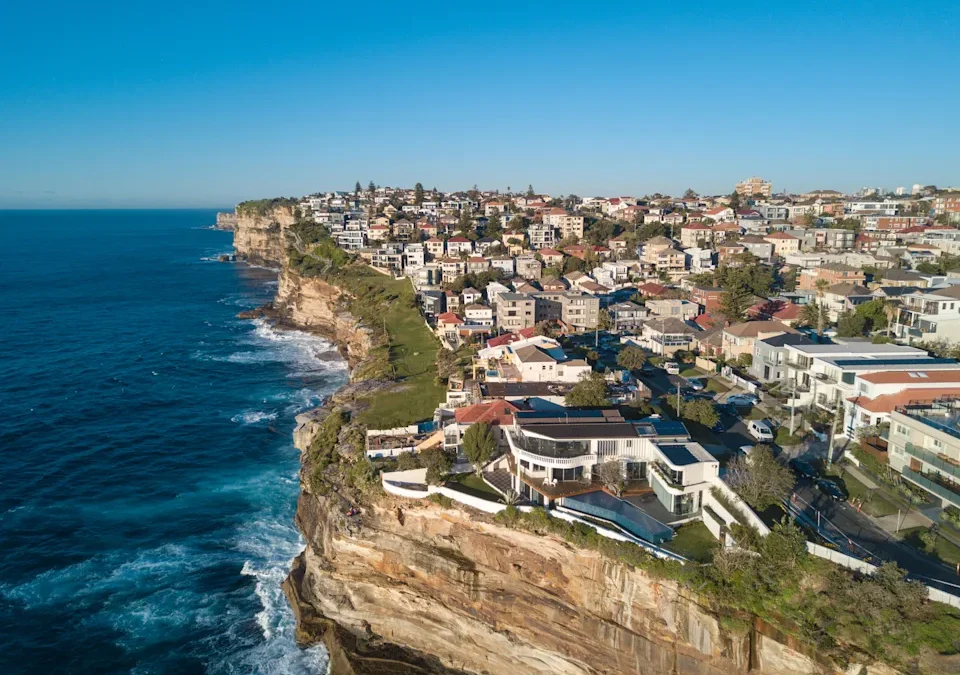
If your home’s anywhere between Bondi and Watsons Bay, or sitting on the harbour foreshore around Vaucluse, Rose Bay or Point Piper, salt air is doing things to your paintwork right now. Whether you can see them yet or not. The ocean’s beautiful. It’s also corrosive.
Salt air doesn’t just speed up normal fading. It changes how paint fails, and where. Knowing what to look for, and choosing the right system when you do repaint, can be the difference between a five-year job and a ten-year one.
What salt actually does to exterior paint
Airborne salt settles on your walls, roof, gutters and window frames every day. On a windy onshore day you can feel it on the back of your throat. That same salt is doing three things to your paint:
It pulls moisture. Salt is hygroscopic, which means it grabs water out of the air and holds it against your surfaces. That sustained dampness under the paint film is what causes blistering, lifting and adhesion failure. South and east-facing walls cop it worst, since they don’t get baked dry by the afternoon sun.
It accelerates UV damage. Salt crystals scatter and concentrate sunlight against the paint surface. Combined with Sydney’s UV index sitting in the extreme range for most of summer, this speeds up the chalking process. If you wipe your hand down an exterior wall and it comes back white and dusty, that’s chalking. The binder in the paint has broken down and you’re touching pigment.
It eats metal. Anywhere you’ve got steel, iron or even galvanised metal, salt accelerates corrosion. Rust then pushes the paint off from underneath. This is why coastal homes typically see paint failure on gutters, downpipes, balustrades, security doors and garage doors years before the walls themselves need attention.
The suburbs that cop it worst
Anywhere within roughly two kilometres of the coast gets meaningful salt exposure. The closer you are and the more exposed your aspect, the faster the damage. In our service area, the worst affected properties tend to be:
- Direct ocean frontage in Bondi, Bronte, Tamarama, Coogee, Maroubra and Clovelly
- Cliff-top homes in Dover Heights, Vaucluse and Watsons Bay
- Exposed harbour positions in Point Piper, Rose Bay and Double Bay
Even a few streets back, prevailing onshore winds carry salt well inland. Homes in Bellevue Hill, Woollahra and Paddington still pick up enough salt to shorten paint life noticeably compared to a comparable property out west.
Signs salt is already getting to your paint
You don’t need to wait for paint to start peeling. Earlier signs to watch for include:
- Chalking when you run your finger along an exterior wall
- Tiny pinhead bubbles in the paint film, especially on rendered walls
- Rust streaks running down walls from nail heads, balustrades or window frames
- White crystalline deposits sitting on the paint surface (that’s the salt itself)
- Patchy fading where some sections look noticeably more washed out than others
- Mould on shaded walls, since salt holds the moisture mould needs to grow
If you’re seeing more than one of these, the paint film is compromised. Repainting at that stage gives better results than you’d expect, because you’re not just refreshing the look, you’re restoring the barrier protecting the substrate underneath.
For a broader rundown of when a repaint is overdue, our guide on signs your Sydney home needs repainting covers the full list.
Choosing the right paint system for a coastal home
The cheapest exterior paint on the Bunnings shelf will fail fast on a coastal home. That’s not a snobby observation, it’s chemistry. You want a system designed for high UV and salt exposure. A few specifics worth knowing:
For rendered or masonry walls
Look for a high-build 100% acrylic exterior product. Dulux Weathershield and Taubmans All Weather both perform reliably in coastal conditions. For walls with hairline cracking, a flexible membrane product like Dulux AcraTex bridges the cracks and seals against moisture ingress, which matters more on the coast than anywhere else.
For metal trim
Never paint over rust. The whole job will come back to bite you inside a year. Surfaces need to be wire-brushed or sanded back to bare metal, treated with a rust converter where needed, primed with an etch primer (for aluminium) or zinc-rich primer (for steel), then finished with a marine-grade enamel. Skip a step and you’ll be doing it again soon.
For timber
Weatherboards, fascias and decks all need different approaches. Decks generally do best with a penetrating oil-based stain that lets the timber move. For weatherboards and fascias, a high-build acrylic system with the right primer holds up far longer than a single thick topcoat.
BrushUp Painting Tip: The other half of the equation is prep. Salt has to come off the surface before anything goes on. That means a thorough fresh-water pressure wash, sugar soap on heavy deposits, and full drying time before paint touches the wall. Skipping the wash is the single most common reason coastal repaints fail early.
How often coastal homes realistically need repainting
For inland Sydney, eight to twelve years on an exterior is reasonable with a quality paint system. Coastal homes need to adjust expectations:
- Direct ocean frontage: 5 to 7 years on walls, 3 to 5 years on metal trim
- Within 1km of coast: 7 to 9 years on walls, 4 to 6 years on metal
- 1 to 2km back from coast: 8 to 10 years on walls
Roofs are a separate conversation. Our guide on the best roof paint for Australian homes covers the systems that handle Sydney’s coastal climate. For a full cost breakdown by home size, see how much it costs to paint a house in Sydney.
What you can do between repaints
You can extend the life of any coastal paint job significantly with a bit of basic maintenance:
- Rinse exterior walls with fresh water every few months, especially after big storms or sustained onshore winds. A garden hose is enough. You’re flushing salt deposits off before they sit and pull moisture into the film.
- Inspect metal trim annually for early rust spots and treat them before they spread under the paint.
- Cut back vegetation that traps moisture against walls and holds salt residue in.
- Touch up small damage early rather than waiting for the next full repaint.
If you’re not sure whether your property’s ready for a repaint or has another year or two in it, a quote with us includes a walk-around where we’ll point out what’s salt damage versus normal wear, and what’s worth fixing now versus monitoring. Have a look at our residential painting services or get in touch for a free quote.
Frequently Asked Questions
How far from the coast do I need to be before salt air stops mattering?
Direct salt spray drops off after about two kilometres inland, but airborne salt carried on prevailing winds can still affect paint life noticeably up to five kilometres from the coast. In Sydney’s Eastern Suburbs, effectively every property sits in the salt zone to some degree.
Can I just use a more expensive paint and skip the surface prep?
No. Salt sitting on a surface acts as a barrier between the paint and the substrate. Even the best marine-grade product will lift within twelve to twenty-four months if it’s applied over salt deposits. On coastal work, prep is non-negotiable. Cutting corners there always shows up faster than it would inland.
My gutters are rusting through. Can they be painted or do they need replacing?
Depends on how far gone they are. Surface rust and light pitting can be treated, primed and repainted. Once the metal has perforated or structural integrity is compromised, replacement is the only real fix. A qualified painter will tell you honestly which category yours fall into rather than painting over a problem.
Is there a best time of year to repaint a coastal home in Sydney?
Autumn (March to May) and spring (September to November) are ideal. Lower humidity means paint cures properly, and you avoid both summer storm activity and the salty westerlies that pick up in winter. Avoid scheduling exterior work during king tides or major storm systems if the forecast is showing one.
How can I tell if my paint job is failing from salt or just from age?
Salt damage tends to be patchy and concentrated on exposed faces, with chalking, blistering and rust streaks as the main signs. Age-related failure is more even, mostly showing as fade and dullness across all walls. If your north-facing wall still looks decent but the ocean-facing one is wrecked, that’s salt doing the work, not time.
Frequently Asked Questions
How far from the coast do I need to be before salt air stops mattering?
Direct salt spray drops off after about two kilometres inland, but airborne salt carried on prevailing winds can still affect paint life noticeably up to five kilometres from the coast. In Sydney’s Eastern Suburbs, effectively every property sits in the salt zone to some degree.
Can I just use a more expensive paint and skip the surface prep?
No. Salt sitting on a surface acts as a barrier between the paint and the substrate. Even the best marine-grade product will lift within twelve to twenty-four months if it’s applied over salt deposits. On coastal work, prep is non-negotiable. Cutting corners there always shows up faster than it would inland.
My gutters are rusting through. Can they be painted or do they need replacing?
Depends on how far gone they are. Surface rust and light pitting can be treated, primed and repainted. Once the metal has perforated or structural integrity is compromised, replacement is the only real fix. A qualified painter will tell you honestly which category yours fall into rather than painting over a problem.
Is there a best time of year to repaint a coastal home in Sydney?
Autumn (March to May) and spring (September to November) are ideal. Lower humidity means paint cures properly, and you avoid both summer storm activity and the salty westerlies that pick up in winter. Avoid scheduling exterior work during king tides or major storm systems if the forecast is showing one.
How can I tell if my paint job is failing from salt or just from age?
Salt damage tends to be patchy and concentrated on exposed faces, with chalking, blistering and rust streaks as the main signs. Age-related failure is more even, mostly showing as fade and dullness across all walls. If your north-facing wall still looks decent but the ocean-facing one is wrecked, that’s salt doing the work, not time.
Ready to get your home painted by experienced professionals? Contact BrushUp Painting today on 0413 655 514 or email mosi@brushuppainting.com.au for a free, no-obligation quote. We’ll handle the preparation, the painting, and the clean-up — transforming your space with expert craftsmanship.